Thursday, May 24, 2018

Kerala Nipah crisis: Man who contained virus in 2001 sees no need to panic

To stop the spread, you may need to quarantine the area, says Dr NK Ganguly, former director, ICMR

When the first outbreak of Nipah (NiV) hit India in 2001 at Siliguri, NK Ganguly, the then director general, Indian Council of Medical Research (ICMR) and Director General of Health (DGH) was there to oversee, supervise and understand what was happening on the ground. Dr Ganguly is a Microbiology specialising in tropical diseases. Currently, Dr Ganguly is the President of Apollo Hospitals Educational and Research Foundation (AHERF). He wrote the first paper in India on the Nipah virus.
Excerpts from an exclusive interview.
When and where did the first outbreak in India take place?
In India, the first outbreak happened in 2001 at Siliguri. The spread was very fast and people died. The dead were mostly nurses and caregivers. People who were in close proximity of the affected.
How was the infection/ Nipah virus identified?
Though the first reported outbreak happened in Malaysia in 1998, so the sequence of virus was available even though the strain in Siliguri was different.
We collected samples and cultured them and we found a vaccine strain that cannot infect further in case of Siliguri. So we started looking in-depth and found that it was the fruit bats which were responsible. If a fruit half eaten by fruit bat was eaten by a human, the saliva which the bat left behind caused the disease in human beings. It causes brain fever, respiratory disorder and the only option is to give symptomatic refilled. But you have to ensure that the caregiver is adequately protected because it is contagious.
A similar Nipah viral attack happened in Dhaka (2006). Once again the culprit was a bat although the sequence was different. It was contained quickly once the virus was identified.
What can be done to contain the fallout?
It spreads in an area where bats live, they live in high concentration and since they also spit and their excreta is around, so there is high concentration of the virus. It makes the population vulnerable. To stop the spread, you may need to quarantine the area. There are high frequency sound waves that only bats can identify, using those you need to disperse the bats. Even culling is not required.
Make sure that you isolate the patient and the caregivers take adequate precautions.

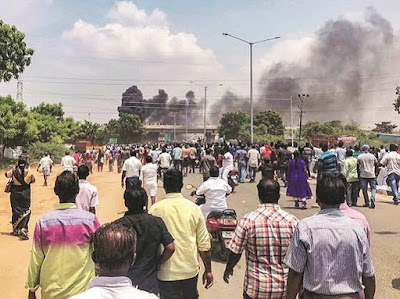
Sterlite protests: Madras HC stays construction of new copper smelter

For almost 100 days now, agitators had been protesting against the capacity expansion by Sterlite Copper; they claimed that the plant was causing harm to its employees

Tuticorin, Tamil Nadu: The Madras High Court's Madurai Bench on Wednesday stayed the ongoing construction of a new copper smelter at Sterlite Copper's Tuticorin plant.
A day before, as many as 11 people had been killed and 20 others injured at Thoothukudi, or Tuticorin, as a protest against Vedanta's Sterlite Copper unit -- going on for 100 days since the company announced its plans to invest Rs 25 billion in doubling the capacity of its existing facility to 800,000 tonnes per annum -- turned violent. The protesters claimed the plant had been causing harm to its employees and increasing the capacity of the plant would aggravate the problems.
Meanwhile, the Union home ministry has sought a report from the Tamil Nadu government over the incident in Tuticorin.
Following a gas leak in March 2013, the then chief minister late J Jayalalithaa had ordered the plant's closure, following which the company moved the National Green Tribunal. With the tribunal overturning the government order, the state moved the Supreme Court against it, and the petition has been pending since.
Here are the top developments in the Tamil Nadu protests:
1. The Madras High Court's Madurai Bench on Wednesday put a stay on the ongoing construction of a new copper smelter by Sterlite Copper in Tuticorin under its capacity expansion efforts, according to ANI reports.
2. Marumalarchi Dravida Munnetra Kazhagam(MDMK) Chief Vaiko on Wednesday met those injured during protests against Vedanta's Sterlite Copper.
Makkal Needhi Maiam (MNM) chief Kamal Haasan also met those who were injured during the anti-Sterlite protests at General Hospital in Tuticorin. The families of the victims said they were facing difficulties because of his visit and asked him to leave, ANI reported.
MNM, along with other Opposition partiesm, had condemned the violence that took place on Tuesday and blamed the AIADMK-led Tamil Nadu government for the unrest and deaths in the state.
3. DMK has called for an all-party protest on May 25 over the Sterlite protest incident.
4. In a government statement, Tamil Nadu Chief Minister E Palaniswamy announced Rs 1 million for those who lost family members, Rs 300,000 for people who were injured severely, and Rs 100,000 for those with minor injuries..
5. In an official statement, Sterlite Copper late on Tuesday expressed regret and sorrow over the deaths that took place during protests against it in Tamil Nadu's Tuticorin. The company said it had appealed to the government to ensure safety of the employees of the plant, as well as the surrounding communities.
"It's with great sorrow and regret that we witnessed today's incidents around the protest today at Tuticorin. The company has appealed to government and authorities to ensure the safety of our employees, facilities and surrounding communities. Sterlite Copper plant is non-operational as we await approval for the consent to operate," the statement read.

Karnataka CM Kumaraswamy says have stopped Modi's Ashwamedha horse: Updates

H D Kumaraswamy's swearing-in as Karnataka chief minister saw a show of strength by a galaxy of Opposition leaders who are looking to unite in a bid to take on Narendra Modi in 2019

Karnataka Chief Minister H D Kumaraswamy has said that the Janata Dal (Secular) and Congress alliance has succeeded in "tying" Prime Minister Narendra Modi's Ashwamedha horse (victory horse) in Karnataka, insinuating that the Modi-Amit Shah duo's electoral juggernaut has been halted. On Wednesday, Kumaraswamy was sworn in as the 25th chief minister of Karnataka in a ceremony in Bengaluru that brought together anti-Bharatiya Janata Party (anti-BJP) regional and Opposition parties on a single platform ahead of the 2019 Lok Sabha elections.
"I had said after the Uttar Pradesh election results came out that my aim is to tie the Ashwamedha horse of Narendra Modi and Amit Shah (BJP President). Today, both Congress and JD(S), together, have tied their Ashwamedha horse in Karnataka," said Kumaraswamy, adding, "Probably, in the days to come, Amit Shah has to go to Narendra Modi with lifeless Ashwamedha horse, as we have tied their horse."
The swearing-in ceremony, which also saw Congress' G Parameshwara sworn in as Karnataka deputy chief minister, showcased rare scenes of bonhomie between United Progressive Alliance (UPA) Chairperson Sonia Gandhi, Congress President Rahul Gandhi, Nationalist Congress Party (NCP) chief Sharad Pawar, Bahujan Samaj Party (BSP) supremo Mayawati, Nationalist Trinamool Congress (TMC) chief and West Bengal Chief Minister Mamata Banerjee, Telugu Desam Party (TDP) chief and Andhra Pradesh Chief Minister N Chandrababu Naidu, Kerala Chief Minister Pinarayi Vijayan, Puducherry Chief Minister V Narayanasamy, Aam Aadmi Party (AAP) chief and Delhi chief minister Arvind Kejriwal, Samajwadi Party chief Akhilesh Yadav, Communist Party of India (Marxist) General Secretary Sitaram Yechury, Communist Party of India Member of Parliament D Raja, Rashtriya Lok Dal (RLD) chief Ajit Singh, Rashtriya Janata Dal (RJD) leader Tejaswi Yadav, and former Union minister Sharad Yadav.
The BJP, for its part, decided to abstain from attending the swearing-in ceremony despite seven of its leaders, including former chief ministers Sadananda Gowda, Jagadish Shettar and S M Krishna, Union minister Ananth Kumar, and officiating Assembly Speaker K G Bopaiah, being invited. The BJP emerged as the single largest party after the May 12 Assembly elections and had formed a government with B S Yeddyurappa as the chief minister that lasted for all of three days. Yeddyurappa said they were boycotting the event as BJP was observing a "black day" across the state.
Here are the top ten developments regarding government formation in Karnataka and Kumaraswamy taking oath as chief minister:
1) Kumaraswamy says Congress, JD(S) have buried the hatchet to work together:Kumaraswamy allayed fears over the working and stability of the Congress-JD(S) coalition government. "I would like to convey to the people of Karnataka that they need not worry about the survival or duration of our government even after the trust vote as we (JD(S) and Congress) have buried the hatchet to work for the state's development as alliance partners," the chief minister said.

Wednesday, May 23, 2018

Infosys puts a break on fresher hiring, relying more on experienced hands

Share of young engineers in 18-25 age group drops to 28% in FY18, senior staff ratio goes up

India’s second-largest information technology company, Infosys, is relying more on experienced hands than fresh graduates even though it weighs to its costs, according to the company’s latest annual report. This is happening when the sector is witnessing slower growth with increasing pressure on profit margins.
According to the latest annual report for 2017-18, the percentage of the Bengaluru-headquartered company’s employees in the age group of 18-25, came down to 28.16 per cent, from 31.19 per cent in the previous financial year. In absolute terms, the number of employees in this group was 57,475, against 62,489 in FY17. Employees in this group largely constitute of newly-hired engineers from colleges.
The percentage of employees above this age group had gone up during this period. For example, employees in the age group of 26-30 constituted 32.25 per cent of the total staff strength in FY18, against 32.09 per cent in the previous year. Similarly, mid-level employees in the age group of 31-40, constituted 32.5 per cent, which rose 168 basis points over the previous financial year. The ratio of employees in the 41-50 age group also saw a rise of 100 basis points over the previous financial year to 5.92 per cent. However, despite the higher ratio of experienced staff in workforce, Infosys incurred only 3.6 per cent rise in expenses towards salaries and bonus in FY18 to Rs 346.7 billion.
The change in Infosys’s employee mix also reflects the growing trend of slower fresher hiring by Indian IT firms, expected to gain pace in the current financial year as well. Owing to uncertain demand environment and changes in client demands, Indian IT companies are hiring fewer number of freshers while majority of them are resorting to just-in-time hiring in case of lateral (experienced ones).
“The intake of fresh engineers by Indian IT firms is certainly going to drop further as companies are seen steadily improving their (employee) utilisation rates. While they are no more hiring in bulk through campus recruitment programmes, the normal attrition in higher age groups is also less owing to lesser avenues outside which means the ratio of senior staff that the sector employs will go up,” said Kris Lakshmikanth, chief executive officer & managing director of Head Hunters India.
Infosys said the percentage of senior management level employees in the age group of 51-60 was 1.03 per cent, against 0.90 per cent in FY17.
Employees above 60 years of age constituted 0.19 per cent of the overall strength, which was at 0.14 per cent in the previous financial year.

Tamil Nadu protests: Sterlite plant non-operational after 9 dead in clashes

Protesters have alleged that the plant was polluting groundwater in their area; CM Palaniswami announced a compensation of Rs 1 million (Rs 10 lakh)

At least nine people were killed and another 20 injured on Tuesday on the 100th day of protest against the expansion of Vedanta's Sterlite Copper unit in Tamil Nadu's Tuticorin, also known as Thoothukudi.
Later in the day, Sterlite Copper said it is unfortunate of what happened on Tuesday and called itself to be non-operational, ANI reported.
Protesters have alleged that the plant was polluting groundwater in their area. Sterlite Copper represents the copper unit of Vedanta Limited which operates a 400,000 tonnes per annum-plant in Tuticorin.
Chief Minister Palaniswami said in a statement in Chennai that the protesters took out a procession towards the collectorate in defiance of the prohibitory orders clamped in the specific area in Tuticorin.
Hurling stones and setting government vehicles an78d public property on fire, the agitators went on the rampage in the town, about 600 km from Tamil Nadu capital Chennai.
Police said nearly 5000 protesters gathered near a local church and insisted on taking out a rally to the district collectorate after they were denied permission to march to the copper smelter plant.
Police personnel prepare to tackle a crowd as agitators demanding closure of Vedanta's Sterlite Copper unit entered the 100th day, in Tuticorin, on Tuesday. The agitation turned violent with police opening fire.
Initial pushing and shoving soon led to violent clashes after agitated locals began hurling stones at police and overturned a vehicle. Security personnel used batons and burst teargas shells to break up the protest.
Many were injured in stone-pelting by the agitators, who also set some vehicles on fire. Windscreens of some government cars were smashed and bank premises were attacked by the rampaging mobs.
Police said section 144 of CrPc has been invoked in and around the Sterlite unit to provide security, according to the orders of the Madras High Court.
Meanwhile, a peaceful demonstration was held near the old bus stand in the town, also demanding the closure of the Sterlite unit and the proposed expansion of the plant.
Several shops in this town, Srivaikundam and Oddapidaram remained shut in support of the protest, police said.
The district has been witnessing several protests by locals and others against the Sterlite Copper plant in Tamil Nadu and its proposed expansion.

Tuesday, May 22, 2018

Mandsaur anniversary: First test of Rahul Gandhi's opposition unity effort

Rahul Gandhi's presence in farmers' death anniversary next month will be a litmus test for Opposition unity

A meeting in Budha village of Mandsaur district in Madhya Pradesh could next month turn out to be the first test for Congress President Rahul Gandhi’s promise that his party would be the lynchpin of Opposition unity.
It would also test the popularity of the Shivraj Singh Chouhan-led Bharatiya Janata Party (BJP) government in the state in an election year.
Prominent Opposition leaders, including the Congress president and leading activists, are likely to assemble in Budha village, 20 kms from Mandsaur town on June 6, to mark the first anniversary of the death of six farmers in police firing last year.
On June 6, 2017, six farmers had been killed in police firing in Mandsaur. The farmers were protesting against the abysmal prices for their onion and garlic crops. The incident had triggered sustained farm protests in several parts of the country.
As the Mandsaur firing incident completes a year, garlic prices have hit rock bottom in Madhya Pradesh, while onion rates have again plummeted in the Malwa-Nimar region, the epicentre of the farmers’ agitation.
The meeting is significant since Madhya Pradesh has Assembly elections due in November-December, along with Rajasthan, Chhattisgarh and Mizoram. Theis will also be the last round of Assembly elections before the 2019 Lok Sabha polls.
The Congress party’s Madhya Pradesh in-charge Dipak Babaria confirmed that Gandhi was likely to be in Mandsaur on June 6.
Swaraj Abhiyan’s Yogendra Yadav said leaders of the All India Kisan Sangharsh Coordination Committee, or AIKSCC, an umbrella body 190 farmer organisations, would also be in Budha village on June 6 to pay their respects to the slain farmers.
However, the committee has decided it will stay away from any event organised under the Congress party’s flag. The leaders are not averse to sharing the stage with either the Congress chief or leaders of other political parties. But they have suggested that the meeting to pay respects to the slain farmers be organised by locals, and not under the banner of any political party.
Activist Medha Patkar will lead a march from Badwani to Bhopal, where farmers will observe a symbolic fast on June 5 to protest the Narendra Modi government’s “failure to address farm distress”, said former legislator and AIKSSC leader Sunilam.
All India Kisan Sabha, affiliated to the Communist Party of India (Marxist), will also hold countrywide protests on June 6. In the last one year, the Kisan Sabha has led farmer movements in Rajasthan and Maharashtra, including the ‘long march’ from Nashik to Mumbai a couple of months back.

Amazon may buy 10% in Future Retail for $600 mn, expand offline retail biz

The move comes days after Walmart acquired a majority stake for $16 billion home-grown e-commerce firm Flipkart at a valuation of around $20 billion.

Looking to expand and consolidate its presence in the Indian offline retail market, American e-commerce giant Amazon is in talks with Kishore Biyani-controlled Future Retail to acquire a 10 per cent stake in it, according to a FactorDaily.comreport.
The report comes days after Amazon's global rival Walmart acquired a majority stake for $16 billion in home-grown e-commerce firm and Amazon's main rival in India, Flipkart, at a valuation of around $20 billion. With an increased burden of competition from Flipkart because of Walmart's entry into the sector, Amazon is looking to make inroads into the offline retail sector to enhance its position in India's retail space.
Here are some of the details of Amazon-Future Retail deal as reported by FactorDaily.com :
1. Future Retail's valuation: The deal values Kishore Biyani's Future Retail, the company that owns brick-and-mortar retail outlets like Big Bazaar and Easy Day, at about $6 billion (Rs 40,872 crore).
2. Deal value: Amazon may spend around $500-$600 million to acquire a 10 per cent stake in Future Retail, whose market cap is around $4 billion.
3. Coping up with the competition: After Walmart's backdoor entry into India's e-retail sector through Flipkart, competition is expected to get fierce in the country's e-retail space. To expand its base in the Indian consumer market, Amazon is looking to enhance its business profile through the offline retail channel.
4. Amazon in India: According to a Citi Research report, Indian e-commerce sector is expected to be worth $202 billion in the next 10 years. Amazon is expected to be a major part of this growth, with a 35 per cent market share. The current valuation of Amazon India is pegged at $16 billion.
5. Amazon's previous investments in offline retail: Amazon had previously picked up a 5 per cent stake in Shoppers Stop for $26.35 million (Rs 179.25 crore).
6. Other buyers in the race: Amazon is not the only one eying a stake in Future Retail. Jack Ma's Alibaba and Walmart have also shown interest in it. Discussions are underway and any decision is yet to be taken.
7. What makes Future Retail a good investment target for Amazon? With a series of acquisitions, Biyani has consolidated Future Retail's business and it could be a perfect choice for Amazon to enter into the offline market. Future Retail has 773 stores across the country, Big Bazaar and Easy Day combined. As Amazon wants to build a food and grocery business, it can capitalise on the fact that Future Retail gets 35 per cent of its business from garments and grocery and has a large number of in-house brands in 68 categories.